

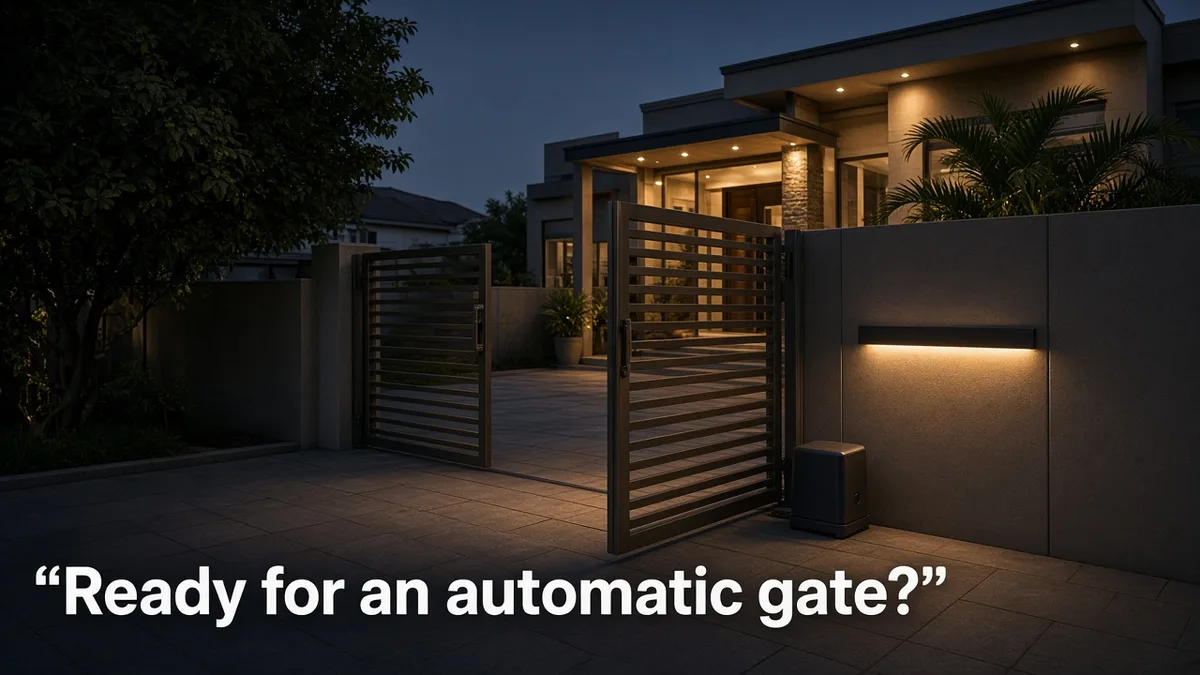
An automatic gate opener turns a driveway entrance into something the family can open from the car, the post, or a phone, without wrestling a heavy leaf in heat, rain, or late traffic. In Pakistan that decision sits on top of an existing gate, a busy street, and load shedding that still hits most neighbourhoods. This guide walks through the buyer path we use on site: survey the entrance, choose sliding or swing motion, size for weight and wind, plan photocells and backup, pick accessories that match daily use, and finish with a clear handover. You can browse the product family on our gate motors hub before you dig into the checklist below.
Think in systems, not boxes. A working electric gate is the motor, the mounting that suits your posts, rack or arms, photocells, a control board, wiring, and often a battery cabinet. Chat-only quotes miss soft plaster, rising hinges, track grit, and wind on a corner plot. Photos help. A short video of the gate moving by hand helps more. Someone standing at the leaf still catches what a catalogue page cannot. Concord Technologies treats gate automation as that full entrance job, and finished sites show up in our portfolio.
Start with a site survey, not a catalogue pick
The survey answers the questions that decide the kit. How wide is the opening? How deep is the apron? Is there run-off space along the wall for a sliding leaf, or clear arc space inside the plot for swing leaves? Does the gate already move true by hand, or does it bind, drop, or scrape? Where will the motor sit, where will the board and battery live, and how will power reach that niche without a wet, temporary cable run?
Street and household habits matter as much as metalwork. A home with frequent daytime cycles needs a different duty picture than a quiet weekend house. Shared walls, parked cars during install hours, and narrow ladder space all affect how the crew works. Outside the city, access and travel shape the schedule more than the basic hardware list. Bring the surveyer clear photos of the leaf, the posts, the apron, and the wall run. If you already have a preferred motion in mind, say so, but stay open if the site fights that choice.
Ask what the survey is checking for. Soft posts, warped track, rusty hinge pins, leaf twist, and wind exposure should all be named before anyone orders a motor. If those points are skipped, you are shopping logos, not specifying a system. When you want to understand how scope shows up on a proposal, read what drives gate motor cost in Pakistan next to this guide. The drivers and the buyer steps are the same conversation from two angles.
Sliding vs swing: pick the motion that fits the plot
Gate type is the first real fork. A sliding gate motor rolls the leaf sideways on a track or cantilever. A swing gate motor pushes or pulls leaves on hinges. Hardware, civil work, and mounting points differ, so the packages cannot be identical. If you are still choosing, start with sliding vs swing gate motors, then come back here with a clearer site picture.
Sliding suits wide openings with a shallow apron and enough wall run for the leaf to park. That is why sliding gate motors show up often on urban homes where cars stop close to the gate and swing arcs would hit a car or a planter. The leaf must roll free. Soft, dirt-filled, or warped track makes any motor work harder every cycle. Fix the mechanical path first, then size the opener.
Swing suits leaves that already swing true on sound hinges and posts, with clear space inside the plot for the arc. Older double leaves often stay on swing gate motors because converting to a single sliding panel means rebuilding the gate, not only buying a motor. Dropping leaves, soft masonry, and missing hard stops transfer every problem into the arms. Packing posts and setting stops before automation is not optional when the gate already needs a strong push.
Wrong motion choice hurts twice. First the kit fights the site. Then you redesign the leaf, cut a track, or replace soft posts. Honest talk about space and leaf condition saves more than shopping one badge against another. In Lahore, city pages for sliding gate motors in Lahore and swing gate motors in Lahore add local context. Nationwide, Concord still specifies from the leaf and the entrance, not from a generic plot label.
Leaf weight, size, and wind load
Heavier and taller leaves need a higher motor class. Solid sheet metal, filled frames, and tall decorative cut-outs all push mass up. Add wind on a corner plot and you get peak loads that show up as strain on gears and arms. Undersizing is a classic reason an automatic gate opener sounds fine for a week and then starts stopping mid-travel. The fix is rarely a board tweak. It is a correctly sized operator for the real leaf.
Geometry matters as much as weight. A long single sliding leaf needs clean rack mesh across the full travel. A double swing needs coordinated closing so the leaves meet and the catch lines up. Wind on a tall swing leaf acts like a sail. Two gates that look similar in a photo can still need different motor classes once someone stands at the entrance and feels how the leaf moves in a breeze.
Ask how the installer sized the motor against your leaf, not against a vague residential label. For sliding, rack quality and roller condition sit next to motor class. For swing, hinge geometry and stop positions sit next to arm strength. Soft-start, soft-stop, and limit accuracy also sit inside that class choice. Buying the lightest kit that still moves the leaf once is how gears wear early on a busy family driveway.
Photocells, obstacle behaviour, and manual release
Photocells and obstacle detection are not optional extras on a driveway where kids, bikes, and guests share the apron. They reduce crush risk when someone steps through as the gate closes. Soft-stop and reverse-on-obstacle behaviour should be demonstrated at handover, not described as a future setting. Skipping sensors can make a package look simpler and leave the electric gate less safe than the household expects.
Wide openings need careful photocell placement so street clutter and reflective cars do not cause endless false stops. Safety edges on the leaf add another layer on heavier installs. Manual release must be reachable without drama when power and backup are both gone. A release buried behind cladding or decorative metalwork is a night-time liability, not a finished install. Write safety scope down: how many photocell pairs, where they sit, and whether reverse-on-obstacle is set and tested.
If the boundary also has wall-top fencing, plan isolation so live fence wire does not fight moving gate metal. Fence and gate are separate systems that share a wall. See electric fencing when both jobs are on the same visit. Each system still needs its own correct specification even if the crew arrives once.
Battery backup and load shedding
Load shedding is part of the automatic gate conversation in Pakistan. If the gate dies every time the grid drops, it only helps in daylight. Battery backup adds scope, and that scope grows with motor draw and how many cycles you want after the outage starts. Some homes pair a modest battery with a clear manual key plan. Others want more automated cycles before anyone touches the release. Decide that intent before install day so the cabinet, battery, and wiring are planned with the motor, not bolted on later.
Cabinet location and ventilation matter. Batteries need a dry spot and service access. A board stuffed into a wet niche will fail early no matter how strong the motor class looks on paper. Site survey should include where the backup lives, not only where the motor sits. We cover outage behaviour in more detail in gate motors and load shedding. Backup is one of the clearest reasons two otherwise similar packages diverge: you are specifying hours of usable cycles, or a calm manual plan, not a mystery line item.
Accessories that match how the household enters
Accessories follow the motor choice and they should match real habits. Extra remotes, a keypad at the post, GSM openers for phone access, loop detectors, and magnetic locks are common requests. Mounting points change by gate type. A sliding leaf needs a reliable closed-position catch that still works after a hot afternoon. A double swing needs the meeting point stable so the lock is not fighting a twisted leaf.
Intercom and home automation links are another scope fork. Some families only want remotes. Others want the gate tied into an existing call panel or phone app. Ask to see those details on similar sites rather than only a motor demo on a light show gate. List accessories separately from the motor and civil work so you can trim or upgrade without confusing the core opener package. A clean scope also makes warranty talk clearer when something fails months later.
Do not buy accessories to fill a wishlist. Buy what the household will use every week. A keypad that nobody remembers the code for, or a GSM module that staff never trust, becomes clutter on the post. Walk through a normal day: morning school run, midday deliveries, evening guests, late return after an outage. That story decides remotes, keypad, phone open, and lock better than a catalogue page.
Handover checklist before you sign off
Handover is where a good install becomes a usable system. Do not treat it as a quick remote hand-over. Watch full open and close cycles with soft-start and soft-stop. Confirm photocells reverse the leaf when the beam is broken. Check limit positions so the leaf stops cleanly without slamming the catch. Test manual release with the power off, then return the gate to automatic mode so everyone knows both paths.
Confirm backup behaviour while you are still on site. If a battery is included, ask how many cycles were planned and what happens when the battery is low. If backup is modest, make sure every driver knows where the release key lives. Label remotes for household members and keep a spare plan for lost fobs. Ask what the warranty covers: motor, board, labour, and what site misuse or civil failure excludes. Vague promises are not the same as a written window.
Before you close the job, walk this list with the installer:
- Motion type confirmed for this leaf and this apron
- Motor class matched to weight, size, and wind
- Track, hinge, or post work finished before final tuning
- Photocells placed, reverse-on-obstacle tested, release accessible
- Battery plan demonstrated, or manual plan clear to every driver
- Remotes, keypad, or GSM access working as agreed
- Warranty and after-sales contact written down
Ready for an automatic gate on your driveway?
Send photos of the leaf, the apron depth, and the wall run, plus a short video of the gate moving by hand. We will survey and specify a complete automatic gate opener system for your entrance.
Get a Free Quote Call +92 301 1111991Bottom line
Buying an automatic gate opener in Pakistan works best as a sequence: survey the entrance, choose sliding or swing for the space you have, size for leaf weight and wind, specify photocells and manual release, decide backup for load shedding, add only the accessories the household will use, and refuse to sign off without a real handover. Skip those steps and you get a motor that moves a leaf for a week and then fights the site. Follow them and you get an electric gate that matches how the family actually arrives home in Lahore or elsewhere in Pakistan. When you are ready, request a quote with site photos and we will specify from the gate you have.