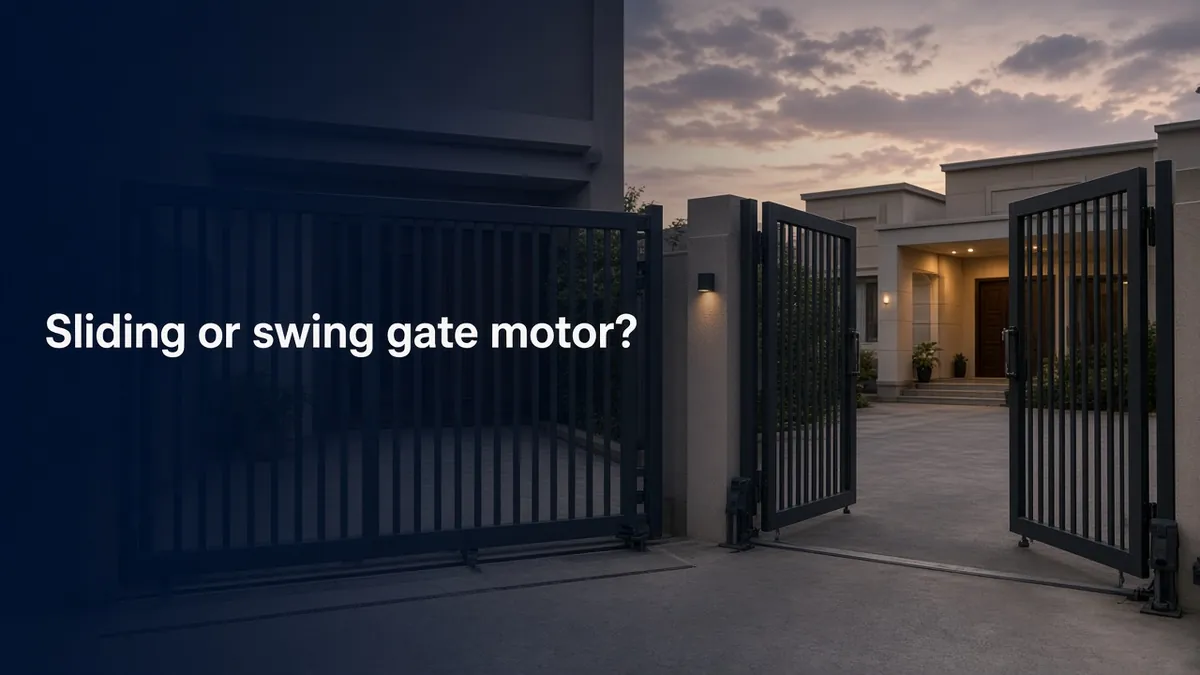
Sliding vs Swing Gate Motors: Which Fits Your Driveway
19 Sep 2026 · ~10 min read · Concord Technologies
Sliding vs swing gate motors is the first real decision once you decide to automate a Pakistani driveway. The motor type has to follow the gate you already have, or the gate you are willing to rebuild. A sliding system rolls sideways on a track or cantilever. A swing system pushes or pulls leaves that open like doors. Both can be quiet, safe, and reliable when sized correctly. Both fail early when the wrong opener is forced onto a heavy leaf, a soft track, or a windy corner with no room to swing. Start with the overview on our gate motors hub, then use this guide to match the site.
People search automatic gate opener, gate motor, and electric gate for the same outcome: open from the car without getting out in rain or late at night. The hardware path is different. Sliding motors care about track straightness, rack mesh, and run-off space along the wall. Swing motors care about hinge health, leaf weight, opening angle, and whether the leaf can clear cars parked inside. If you skip that site talk and only compare box sizes, you will buy the wrong kit.
How a sliding gate motor works
A sliding gate motor drives the leaf sideways using a gear that meshes with a rack along the bottom or mid-rail of the gate. The leaf rides on rollers in a ground track, or on a cantilever system that keeps the leaf off a messy driveway surface. Limit switches or encoder logic stop the gate at open and closed. Photocells watch the opening so the leaf does not crush a person or car. Manual release lets you open by hand when power and backup are both gone.
Sliding wins when driveway depth is short. Many DHA and Bahria plots have a deep house but a shallow apron between the gate and the porch. A swing leaf that opens inward would hit the car or the steps. A sliding leaf needs clear run along the boundary wall instead. That is why sliding gate motors show up so often on urban homes with wide street openings and limited inward swing space.
Sliding fails when the track is ignored. Dirt, stones, warped channel, and soft concrete under the rollers make the motor work harder every cycle. A motor that is “strong enough on paper” still burns out if the leaf binds. Cantilever setups avoid ground track grit but need a solid post structure and correct counterbalance. Either way, the survey should include how the leaf moves by hand before anyone talks about brand badges.
How a swing gate motor works
A swing gate motor moves one or two leaves on their hinges. Common residential kits use articulated arms or linear operators mounted on the leaf and a solid post. Double-leaf entrances need coordinated closing so the leaves meet cleanly and the lock or magnetic catch lines up. Safety edges and photocells still matter because a swinging leaf covers a large arc where kids and bikes pass.
Swing wins when the gate already swings well and you have clear arc space. Older homes with elegant double leaves often look wrong converted to a single sliding panel. If hinges are true, posts are solid, and the leaves open inward without hitting planters or a second car, swing gate motors keep the look and avoid building a long track. Wind load on tall decorative leaves is the catch: a pretty leaf can act like a sail and overload a weak operator.
Swing fails when hinges are tired. Dropping leaves, rusty pins, and soft masonry posts transfer every problem into the motor arms. Automating a gate that already needs a strong push by hand is how installs come back within months. Fix the mechanical gate first, then size the operator to the real weight and the real opening angle, not the brochure photo.
Space, slope, and street conditions
Measure the clear run for sliding along the wall, including any columns, meters, or water points that stick out. The leaf needs somewhere to park when open. If the wall returns too soon, sliding may need a redesign of the leaf length or a different entrance layout.
Measure the swing arc carefully. Inward swing is common in Pakistan so the leaf does not block the street. Outward swing can conflict with footpaths and traffic. Sloped driveways add another layer: a sliding leaf on a bad slope can drift, and a swing leaf can fight gravity on one side. A short site video of the gate moving by hand helps more than a chat-only quote.
Street noise and security habits matter too. Some families want the gate mostly closed and only open for known cars. Others leave it open during daytime for staff. Duty cycle and soft-start behaviour affect wear. Remote range, keypad access, and intercom integration are shared topics for both motor types once the leaf motion is decided.
Weight, wind, and motor sizing
Heavier gates need honest sizing, not the cheapest kit that still “moves” on a demo day. Solid sheet metal, tall decorative cut-outs, and filled frames all push mass up. Add wind and you get peak loads that show up as strain on gears and arms. Undersizing is a classic reason automatic gate openers sound fine for a week and then start stopping mid-travel.
Ask the installer how they sized the motor against your leaf, not against a generic plot label. For sliding, rack quality and roller condition sit next to motor class. For swing, hinge geometry and stop positions sit next to arm strength. Concord Technologies treats gate automation as a system on the entrance you already have, which is also how projects appear in our portfolio.
Safety, photocells, and manual release
Photocells and obstacle detection are not optional extras for a busy family driveway. They reduce crush risk when someone steps through as the gate closes. Soft-stop and reverse-on-obstacle behaviour should be demonstrated at handover. Manual release must be reachable without drama when load shedding outlasts the battery. We wrote more on outage behaviour in gate motors and load shedding.
Backup strategy differs by motor draw, but the question is the same: can you still enter after a long night outage? Some homes pair a modest battery with a clear manual key plan. Others want more automated cycles before they touch the release. Decide that before install day so the cabinet, battery, and wiring are planned with the motor, not bolted on later.
Lahore sites and Pakistan-wide patterns
In Lahore societies, wide street openings with short aprons often push toward sliding. Farmhouses and older bungalows with deep yards and double leaves often stay on swing. The same pattern appears in other cities. For Lahore-specific product pages, see sliding gate motors in Lahore and swing gate motors in Lahore. Outside the city, travel and access affect schedule more than the basic choice between the two motion types.
If the boundary also has wall-top fencing, plan isolation so live fence wire does not fight moving gate metal. Fence and gate are separate systems that share a wall. See electric fencing when both jobs are on the same visit.
Noise and neighbour comfort differ by install quality, not only by motor type. A well-set sliding rack should sound like a controlled roll, not a grind. A swing arm should push smoothly without the leaf slamming the stop. If you hear scraping on day one, stop and fix alignment before software settings are blamed. Soft start and soft stop settings help, but they cannot hide a bent track or a hinge that needs packing.
Accessories should follow the motor choice. Keypads, GSM openers, loop detectors, and magnetic locks are available for both families, yet mounting points change. A sliding leaf needs a reliable closed-position catch that still works after thermal expansion on a hot Lahore afternoon. A double swing needs the meeting point stable so the lock is not fighting a twisted leaf. Ask to see those details on similar sites rather than only a motor demo on a light show gate.
Service access is part of the design. The motor cover should open without removing half the cladding. Manual release should be reachable without climbing decorative metalwork. Battery cabinets need ventilation and a dry spot. These boring points decide whether a five-year-old system is still pleasant to live with. They also decide whether your first night outage is a calm release or a flashlight panic at the post.
Budget talk should stay about scope, not invented street rates. Civil work for a new track, rebuilding a leaf, upgrading posts, photocell posts on a wide opening, and backup capacity all move the quote more than swapping one logo for another. Two homes on the same street can land far apart once those items are counted. Keep the comparison honest: same leaf condition, same safety kit, same backup intent.
Training at handover should cover daily use, not only the remote buttons. Show every driver the soft-stop behaviour, where the photocells sit, and how to use manual release without forcing the leaf. Write the release steps on a small card in the motor cabinet. Families forget under stress. A calm handover is cheaper than an emergency call-out the first time the battery is flat.
A simple way to choose
Use this as a survey checklist:
- Does the leaf already slide or swing cleanly by hand?
- Is there clear run along the wall, or clear arc inside the plot?
- How heavy and how tall is the leaf in wind?
- Where will photocells sit without false triggers from street clutter?
- What backup and manual-release plan do you want for long outages?
If sliding space exists and inward swing is tight, lean sliding. If double leaves already swing true and look is important, lean swing. When both could work, pick the option that needs less civil work and less daily fighting with dirt or wind. When you are ready, request a quote with a short video of the gate moving by hand. That single clip prevents most wrong-motor conversations.
Not sure which motor fits?
Send photos of the gate, the apron depth, and the wall run. We will tell you whether sliding or swing is the honest match before anyone orders a kit.
Get a Free Quote Call +92 301 1111991Bottom line
Sliding gate motors suit wide openings with limited inward depth and a clean sideways run. Swing gate motors suit healthy hinged leaves with clear arc space and a look you do not want to rebuild. Weight, wind, track or hinge condition, photocells, and backup decide reliability more than the brochure. Choose the motion your site already supports, then size the operator to that leaf. That is how automatic gate openers stay useful years after install day.
Related: Gate motors overview · Sliding gate motors · Swing gate motors · Load shedding guide · Contact · All blog posts