

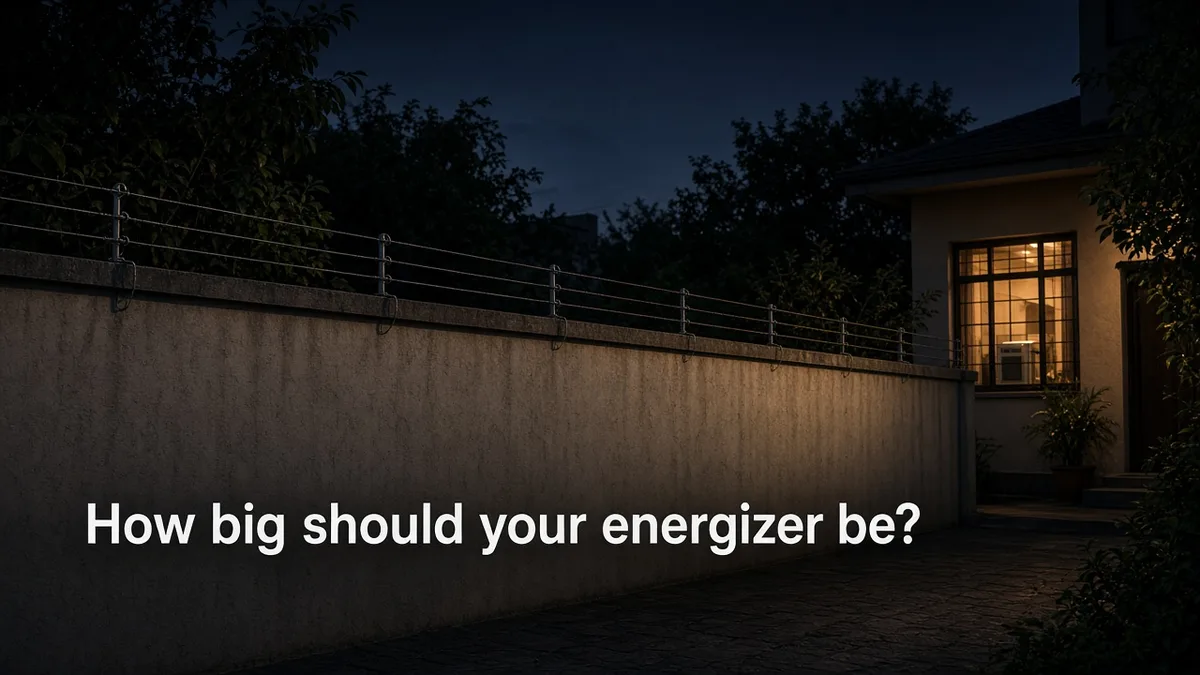
Electric fence energizer sizing is the question that sits behind almost every wall-top fence quote. The rods and wire get the photos. The energizer decides whether that wire still holds a useful pulse after rain, after a vine touches a corner, and after the grid drops at night. On Pakistani homes the usual install is a perimeter on top of the boundary wall, not a farm paddock. That means length, wire count, leakage, earthing, and backup matter more than a catalogue label glued to a box. You can see how we build the full system on our wall-top electric fencing page. This guide explains what sizing means so you can read a survey without guessing.
People search electric fence energizer, fence energizer, and how big should my energizer be for the same reason: an undersized unit looks fine on handover day and feels soft a month later. Oversizing without a clean install does not fix bad joins either. The honest path is to size the energizer against the real wall, then keep the line clear so the pulse is not wasted. If you want the parts story first, start with how an electric fence system works, then come back here for sizing.
What energizer sizing means on a home wall
Sizing is matching stored pulse energy to the load of your fence. Every metre of wire, every insulator, every join, and every plant touch steals a little of that pulse. A short, clean rectangle with few corners is an easy load. A long, stepped society wall with gates, returns, and street trees is a harder load. The energizer has to keep voltage high enough at the far end of the run that a climber still feels a sharp deterrent, not a weak tickle.
Home wall-top fencing is not the same as agricultural fencing. Farm energizers are often rated for kilometres of open wire with different safety and monitoring habits. A Pakistani house wants a residential-class unit, clean terminations, proper earth, and usually battery backup for load shedding. Brand families such as Nemtek and Tongher show up often because support and spare parts patterns are known in Pakistan. The badge still has to be sized to the site. A known logo on an undersized box will not rescue a long, leaky perimeter.
Think of the energizer as the heart of a system, not a standalone gadget. Rods, wire, insulators, feed cable, earth stakes, and monitoring all sit around it. Concord Technologies prices and specifies from that full stack. Finished examples sit in our portfolio. When a quote only names “energizer included” without length, wire lines, or backup intent, you are not looking at a sized job yet.
Perimeter length: the first real number
Wall length is the first hard input. Walk the top of the parapet in your mind: front, sides, rear, and any returns at the gate. Measure the live path the wire will take, not only the plot width on the sale brochure. A corner plot with a deep garden wall can carry far more wire than a compact townhouse frontage that looks similar from the street.
Branches and steps add effective length. Every return, level change, and gate isolation loop adds wire and fittings. Those extras are easy to miss in a phone photo. They still load the electric fence energizer. Two homes in the same DHA block can need different classes once someone counts the real run, not the plot label.
Distance from energizer to the first insulator matters too. A long, unprotected feed through a busy plant room wastes energy and complicates service. Keep the high-voltage path short, protected, and separate from low-voltage control cables. Site survey should include where the box will live, not only how many metres of wall you have.
Wire lines: more strands, more load
Wire count multiplies the work the energizer must do. A three-line wall-top fence and a five- or six-line fence on the same length are not the same load. Extra strands raise deterrence and also raise capacitance and leakage opportunities. Families often ask for more lines for look and climb height. That choice has to sit next to energizer class, not after it.
Wire type and joins affect how clean the load stays. Alloy HT wire is common on residential wall-top systems when it is tensioned and terminated properly. Stainless wire ages more evenly on street-facing runs that see rain and city air. Poor crimps, twisted DIY splices, and loose corner terminations create soft spots that look like “a weak energizer” when the box is fine. Sizing assumes a clean line. A dirty line will always feel undersized.
Insulator quality is part of sizing in practice. Cracked, dirty, or forced insulators leak pulse to the rod or the plaster. After a dusty summer or a monsoon week, that leakage grows. An electric fence that was quiet in March can start nuisance-tripping in August if vegetation and insulator dirt were never part of the handover talk. Clear the physical leaks before you upgrade the energizer.
Vegetation leakage and everyday shorts
Plants are the most common reason a correctly sized energizer feels weak. Bougainvillea, vines, overhanging trees, and washing lines thrown over the wall all steal energy and can trip monitoring. The pulse takes the easy path to earth through wet foliage instead of waiting for a climber. That is not a software problem. It is a maintenance problem that shows up as soft shocks and night-time sirens.
Neighbour walls and shared coping add politics as well as leakage. Metal sheets, satellite brackets, and decorative ironwork that drift into the live zone behave like a permanent short. On survey day, a good team looks up as well as along the parapet. Photos help, but someone standing on the wall still sees what a ground-level camera hides.
Plan a clear strip above the rods and write plant care into handover. Walk the line after storms. Cut back anything that can touch when wet and heavy. If the energizer reports a fault and you can see a branch on the wire, clear the branch before you open a service ticket about “power.” Most after-sales visits start with a physical leak, not a failed board.
Earthing: the path that finishes every pulse
Earthing is half of energizer performance. Without a proper earth return, the fence cannot deliver the shock it was sized for. Dry soil, painted scrap metal, a single shallow stake on a long perimeter, or a bond that was never tightened will all show up as soft contact at the far corner. Sizing the box higher does not fix a missing earth path.
Ask how many earth stakes, where they sit, and how they are bonded back to the energizer. Soil that stays reasonably moist, clean connections, and separation from random underground metalwork matter as much as the joule rating on the label. This is one of the quiet differences between a kit in a box and a system built for the site. Cost drivers around the full package, without turning this into a price list, are covered in what drives electric fence cost in Pakistan.
Backup, load shedding, and battery draw
Load shedding is part of energizer sizing in Pakistan. A fence that dies with the grid only protects in daylight. Battery backup keeps the electric fence pulsing when mains drop. A larger perimeter and more wire lines draw more from the battery each pulse cycle, so backup is not a one-size accessory bolted on later. Decide how long night outages run in your area, then size battery and energizer together.
Ask what happens in a long outage, not only whether “backup is included.” Some packages hold useful voltage for a real window. Others fade early and leave only a local beep. If night-time risk is why you want wall-top fencing, backup intent belongs on the survey sheet next to perimeter length. Cabinet location and ventilation matter too. Batteries need a dry, serviceable spot, not a wet niche behind cladding.
Monitoring sits on top of a fence that already holds voltage. A siren or phone alert is useful when a cut or short collapses the line. It does not replace correct energizer class or plant clearance. Treat monitoring as a messenger, not as a fix for an undersized unit fighting wet foliage all week.
Undersizing symptoms you can spot
A soft shock at the far end of the wall is the classic sign. The front corner near the energizer feels sharp. The rear return feels mild. That pattern often means the load is higher than the unit can carry once leakage and length are counted, or the earth path is weak at that end.
Frequent fault lights without an obvious cut often point to vegetation, dirty insulators, or a neighbour touch. Replacing the energizer first rarely helps. Clear the line, dry the fittings, and retest. If voltage still collapses on a clean, dry morning, then class and earthing deserve a second look.
Backup that dies in the first hours of an outage can mean the battery was never matched to draw, or the energizer is working harder than planned because of leaks. Fix the leaks, then revisit battery capacity. Swapping boxes while vines still hang on the wire only burns another service visit.
Nuisance alarms after rain are common on underspecified or poorly maintained runs. Wet dust on insulators and wet leaves on the lines create temporary shorts. A correctly sized, clean system still needs a walk after heavy weather. An undersized system complains louder and more often.
Lahore homes and the same rules elsewhere
Electric fence Lahore searches are busy because societies such as DHA, Bahria, Gulberg, and Model Town have continuous boundary walls that suit wall-top systems. Length still varies house to house. A deep corner plot is not the same load as a narrow mid-block wall. For city-specific install context, see electric fencing in Lahore and our note on electric fence installs in DHA, Bahria, and society homes.
Outside Lahore, the physics do not change. Perimeter, wire lines, leakage, earth, and backup still decide energizer class. Logistics and access affect schedule more than the sizing rules. Concord works across Pakistan from Plaza 180 in DHA Phase 8, Lahore, so out-of-city work is planned around survey access and a clear wall map, not around a generic kit guess.
Survey checklist before you size the energizer
A serious survey should leave you with named inputs, not vague “premium” language. Photos and a rough sketch help before the visit. Someone on the parapet still confirms plaster quality, coping strength, gate isolation, and plant risk. Bring these points written down:
- Approximate wall length and number of main corners or steps
- How many wire lines you want on street and garden sides
- Where the energizer and battery cabinet can sit dry and reachable
- How long night outages usually last in your area
- Any shared walls, trees, or metalwork that can touch the lines
- Whether you already prefer a Nemtek or Tongher energizer family
On the proposal, ask for energizer class matched to that list, earth scope, backup intent, and wire count in writing. That is how you compare two quotes on the same fence, not on two different imaginary walls. Related reading on cost drivers without printed figures sits in electric fence cost factors in Pakistan.
Want energizer sizing based on your wall?
Send a rough wall sketch, photos of the parapet and corners, and a note on how long night outages run at your house. We will survey and size a complete wall-top electric fence system, not a catalogue guess.
Get a Free Quote Call +92 301 1111991Bottom line
Electric fence energizer sizing for homes starts with the real perimeter, the number of wire lines, how clean the insulators and joins stay, how strong the earth path is, and how much battery backup you need through load shedding. Undersizing shows up as soft shocks at the far corner, early backup fade, and constant fault lights that clear when you cut back plants. Oversizing a box on a dirty line does not fix leakage. Size the energizer against your wall, keep vegetation clear, and put backup on the same survey sheet. When you are ready, request a quote with site photos and we will match the electric fence energizer to the boundary you actually have in Lahore or elsewhere in Pakistan.